
 Alternative to current loop fuse buddies
I bought the two fused current loop fuse buddies from AES Wave for connecting amp probes at fuse boxes and found out that some fuse boxes I was not able to fit between some obstructions to plug them in , and some engine compartment fuse boxes have large rectangular specialty fuses , male or female style terminals where the current loop fuse buddy application that would work is not offered for sale. I think I could have just bought some ATO fuse holders and crimped on some different size spade terminals with a little additional wire .
-
-
good slo/rainy day project,
I have some made out of old/extra wiring connector parts along with
some extra terminals/wire crimped on as you mentioned.
some fit the mini fuses perfectly, I add a little heatshrink to add
insulation and a small ziptie on loose wires to hold ,
and some I have used fuse holders inline.
Make nice little fused jumpers/current loop at the relay terminals or
fuse block.
Along with some regular jumper wires and GTC CT6100 Fuse Socket Connector Kit I can tap in as needed,
the rectangular fuses will need the spade terminals, maybe make some out a fuse with wires ?
As fuse blocks get smaller and more cramped its hard to get into
them especially if they are underdash or awkward location. -
I made my own from ones like these several years ago.
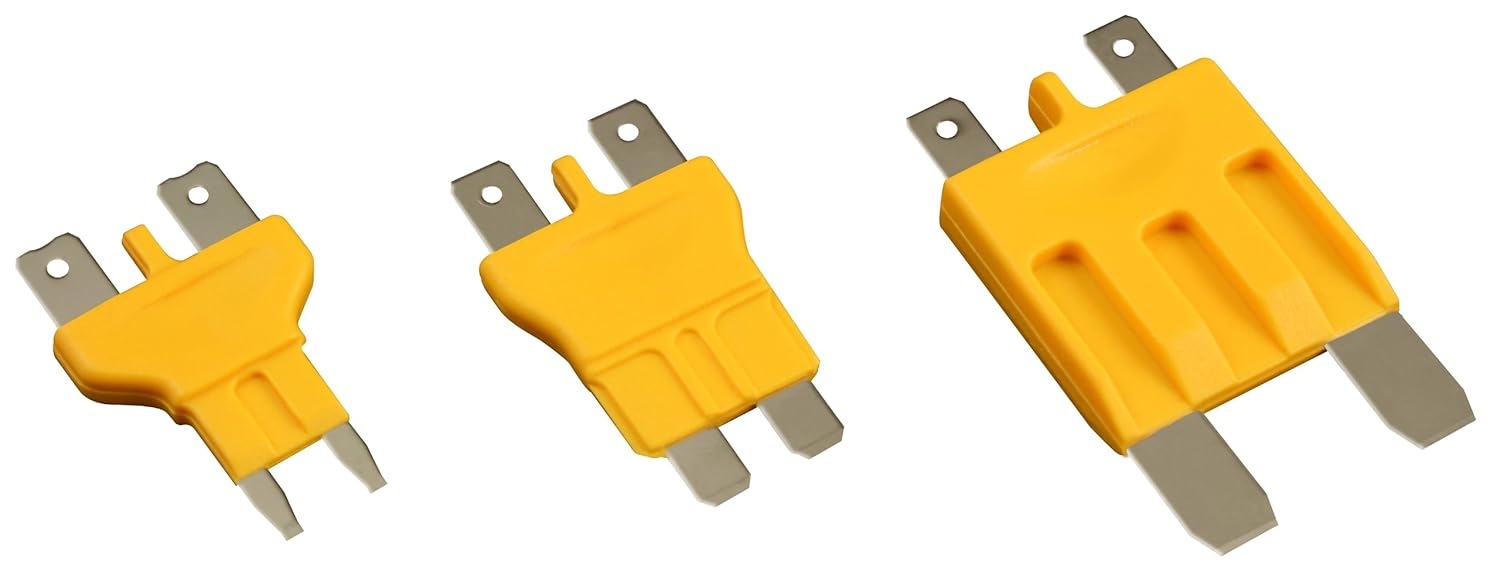
Comment
-
My version
I like to use self resetting circuit breakers for this. I attach female 1/4" fast on connectors to two wires to connect to one of a set of circuit breakers [of the appropriate amperage]. See breaker linked below.
The other ends of the wires have male fast on terminals appropriate for either ATO [1/4" male] or ATM fuse boxes. Witsend, doesn't it go against your religion to have to keep buying more fuses? I thought you were frugal?
These circuit breakers are available in 10, 15, 20, 25 & 30 amp ratings. I got mine from my local parts vendor. Wires can be quickly fabricated for length, AWG & fuse block terminal requirements.
I'll probably get a set of the adapters recommended by Maven, to simplify connection to the fuse box. I've had them on my Amazon Wish List for a month or two now.Comment
-
Waytek absolutely has great stuff, I source all my wire from them. Thy have some of the absolute best pricing on TXL wire anywhere, and probably the best that offers instant online ordering in relatively small quantities(under 500ft) I love being able to order a 100 or 250 ft spool of wire anytime I want at a great price without having to submit a quote for the damn stuff. They also have EXCELLENT pricing on adhesive lined heat shrink, especially if you buy it in uncut 4ft lengths. Plus virtually everything I use commonly is available American made from them, and at prices competitive to Chinese **** from the local suppliers.Comment
-
Waytek Wire & PIDG Connectors RULE!
Agreed on all of the above. However, probably the best deal they have is on their electrical crimp connectors. I'm talking about butt connectors, ring connectors, male and female fast on connectors, etc. Waytek sells aircraft quality PIDG [Pre- Insulated Diamond Grip] connectors for the same or lower price than the garbage connectors your local auto parts store sells you. PIDG connectors are superior in two ways. First, the insulation is Nylon, rather than some lower form of plastic. Second, inside the insulated barrel, you will see that the steel barrel inside is longer and is of two diameters. The larger diameter section of the steel barrel is designed to crimp over the end of the insulation on the wire. This gives the insulated portion of the wire superior support. It prevents the bare wire from vibration or fatigue fracturing just shy of the insulation. PIDG connectors are the standard for aviation use. They require a "double crimp". One crimp of the bare wire to the barrel and another crimp to retain the end of the insulation to the barrel. If you are unfamiliar with PIDG connectors and crimpers, I suggest you check the following links.

Look carefully at the photo below and you can see that the steel barrel inside the insulation comes almost to the end of the insulation. The "junko" connectors sold at the auto parts store do not have this superior barrel design feature.

CharlieComment
-
Waytek has more sizes
Once upon a time, the only size female fast on connectors you were likely to encounter, were the common 1/4" variety. With today's cars, you need to have 3/16", 1/8" and other smaller sizes of this popular connector. Often, your local parts vendor, doesn't stock these sizes. Waytek Wire has them all and they are PIDG.
CharlieComment
-
Nice!Excellent information ,As a bottom feeder fixing beaters and not aircraft , I just have generic crimping pliers , and when in doubt of my crimps I will tin the ends of the wire to the terminal with solder with a cheap set of helping hands and marine shrink tubing . I highly recommend the smaller cheaper version of helping hands to solder things, but this one looks like a larger deluxe version . Very Small terminals replaced in tight connectors deserve a quality crimping tool to crimp as well as original because any solder migration might bulk things up and prevent the terminal from sliding in and locking into the connector properly
Last edited by Witsend; 01-06-2015, 08:08 AM.Comment
-
No problem
The double crimper tool can be had for about $20. That said, in a pinch, you can do the second crimp [on the insulation to barrel section] using the next larger gauge section of your single crimpers. ie When crimping 22 - 18 AWG [red] connector, crimp the bare wire area using the 22-18 AWG jaws. Then crimp the insulation to barrel area using the 16 -14 AWG jaws.
It's always nice when you can use superior parts and do a superior job for the same or less money spent on the connectors. Once you start to use PIDG connectors, you won't want to use anything else. I HATE come backs!
Charlie
PS I have the "helping hands". Great tool.Comment
-
Unable to test some newer style micro ASD fuses without removal
I believe it was a German car I had in awhile back , where the normally probe- able 2 sides of fues (with a sharp point of a test light or power probe) were no longer accesible and sealed off from any probing. Requires pulling the fuse out and checking unless there is some Factory Farfignuegen Feature on the Factory scantool that displays images of the fuse box(s) and has a flashing leds over the code's suspect circuit fuse positions to guide you to inspect specific fuses of the circuit for a specific DTC .That would be too simple, I think it's just another Dickish move to get simple things to become a proprietary PITA to service.Comment
-
I dont use pre-insulated connectors, nylon, vinyl PVC or otherwise.
I use non-insulated terminals and a crosslinked/adhesive lined heat shrink. This allows for smalller/lighter connections and bundles (which also looks better) and better wire strain relief at the terminal crimp, not to mention improved weather resistance to the conductors. It also allows me to easily solder the connection if I choose to. Ive even been transitioning away from crimp-n-seal type butt connectors to crimp and soldered non insulated splices covered with sealed heatshrink. Again smaller/cleaner wire bundles, and improved weather resistance.Comment
-
I have seen these on the Pico site
Fuse Extension leads;
PP 408 - ATO/ATC
TA 168 - J Case Fuse
TA 206 - New Maxi FuseComment


Comment